
Why the BIRD is necessary and important
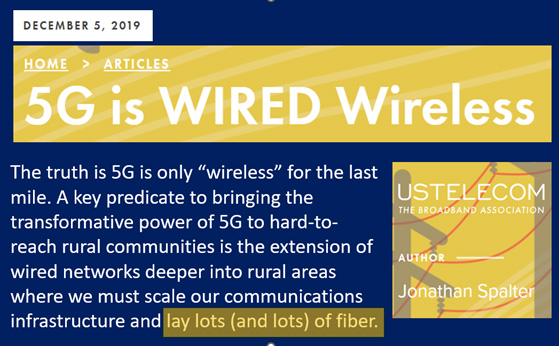
US Telecom CEO stated, we must lay lots(and lots) of fibers to build network infrastructure to reach universal connectivity

The Kathmandu Post, April 19, 2018: Nepal is eager to
implement remote education in rural areas.
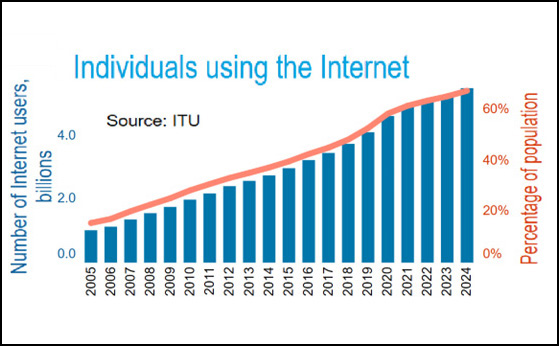
ITU estimates that approximately 5.5 billion people are using the Internet in 2024. However, this leaves 2.6 billion people still offline.
The challenge in the AI era is not “connected” but “AI-Grade Connectivity”.
The AI revolution entered a phase of significant social transformation after 2023. AI is becoming a fundamental social technology in education, healthcare, administration, industry, and more. The prerequisite for this is AI-Grade Connectivity. While there is no official international definition yet, based on ITU-T QoS recommendations and industry knowledge, we consider the following to be practical guidelines:
Communication speed: 10-30 Mbps or higher, latency: 10 ms or less, stable and always-on connection.
According to the ITU’s Facts and Figures 2025, the number of internet users in 2025 will reach approximately 6 billion (about 75% of the world’s population). However, approximately 2.2 billion people will still be offline. Even more importantly, “6 billion users” and “people who can fully utilize AI” are not the same. Currently, the population that can utilize AI-Grade Connectivity is estimated to be only about 1-2 billion people worldwide.
While the ITU has yet to release official statistics on the number of AI users, some private surveys already estimate the number to be around 1 billion. The rate of AI adoption is said to be exceeding that of the early internet. The question is not “who has internet access,” but “who has the communication environment to utilize AI.” The widespread adoption of AI-Grade Connectivity is becoming a fundamental condition for the sustainability of global society, transcending humanitarian challenges.
As early as March 14, 2024, the U.S. Federal Communications Commission (FCC) raised its definition of fixed-line broadband from the previous 25/3Mbps to 100/20Mbps, and further proposed 1/0.5Gbps as a future reference value. This indicates that broadband is now required to meet a higher standard as a foundation for an AI society.
The 2024 UN AI Advisory Committee report pointed out that “developing countries are at risk of being left behind,” and an IMF analysis in January 2024 also stated that “while AI will bring about increased productivity, it may also widen disparities between nations,” and analyzed that it could lead to “worsening social tensions and inequality.”
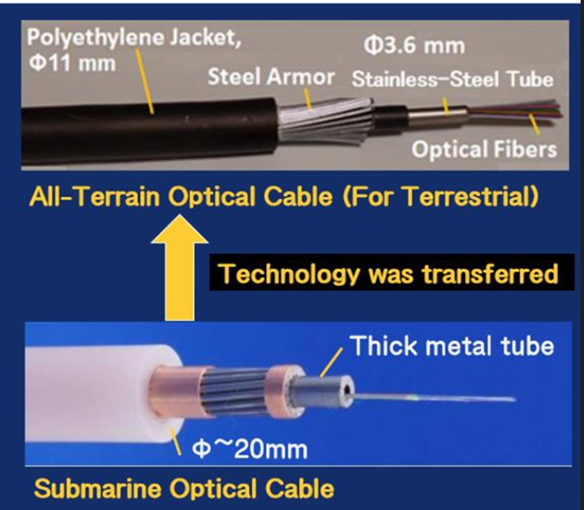
Solution BIRD was developed as a “backhaul line” connecting backbone lines with e.g, mobile base stations in remote locations. Its innovative, lightweight, and durable optical cable based on submarine cable technology and unique installation concept enable the simple, inexpensive, reliable, and rapid deployment of high-speed Internet even in areas where installation was previously difficult, BIRD can be deployed across virtually any terrain—including mountains, jungles, deserts, lakes, marshes, and peatlands—provided obviously hazardous locations are avoided.
The BIRD concept was devised by Global Plan CEO, Dr. Okamura, and technical requirements were discussed at ITU-T SG5 and SG15. By 2019, it had been internationally standardized as the first three ITU Recommendations explicitly addressing the “elimination of the digital divide.”
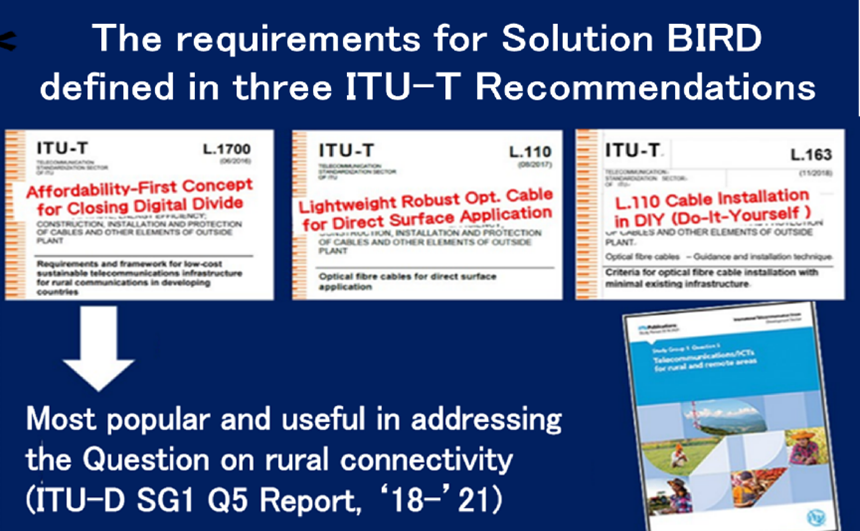
See the following ITU news:
Details of the BIRD
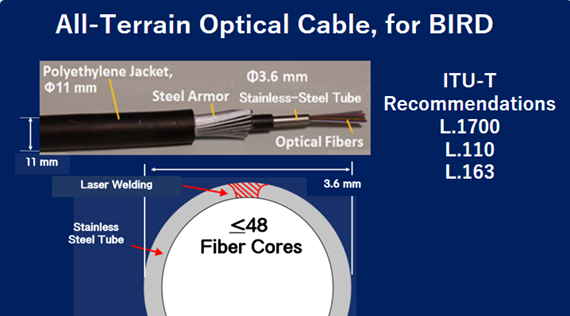
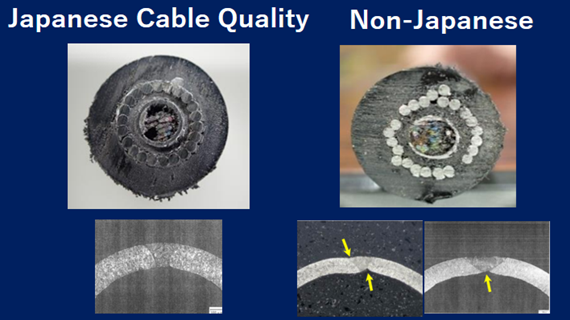
A land-use optical cable based on submarine optical cable used in Solution BIRD. Up to 48 optical fibers are protected in a welded thick stainless steel tube. The cross sections of similar optical cables show “Japanese quality”.
Mr. Okamura being interviewed about Solution BIRD at WTSA2019